The Center for Wellbeing Participates in the Annual Dialogue of the Ministry of Education and Higher Education
About This Event
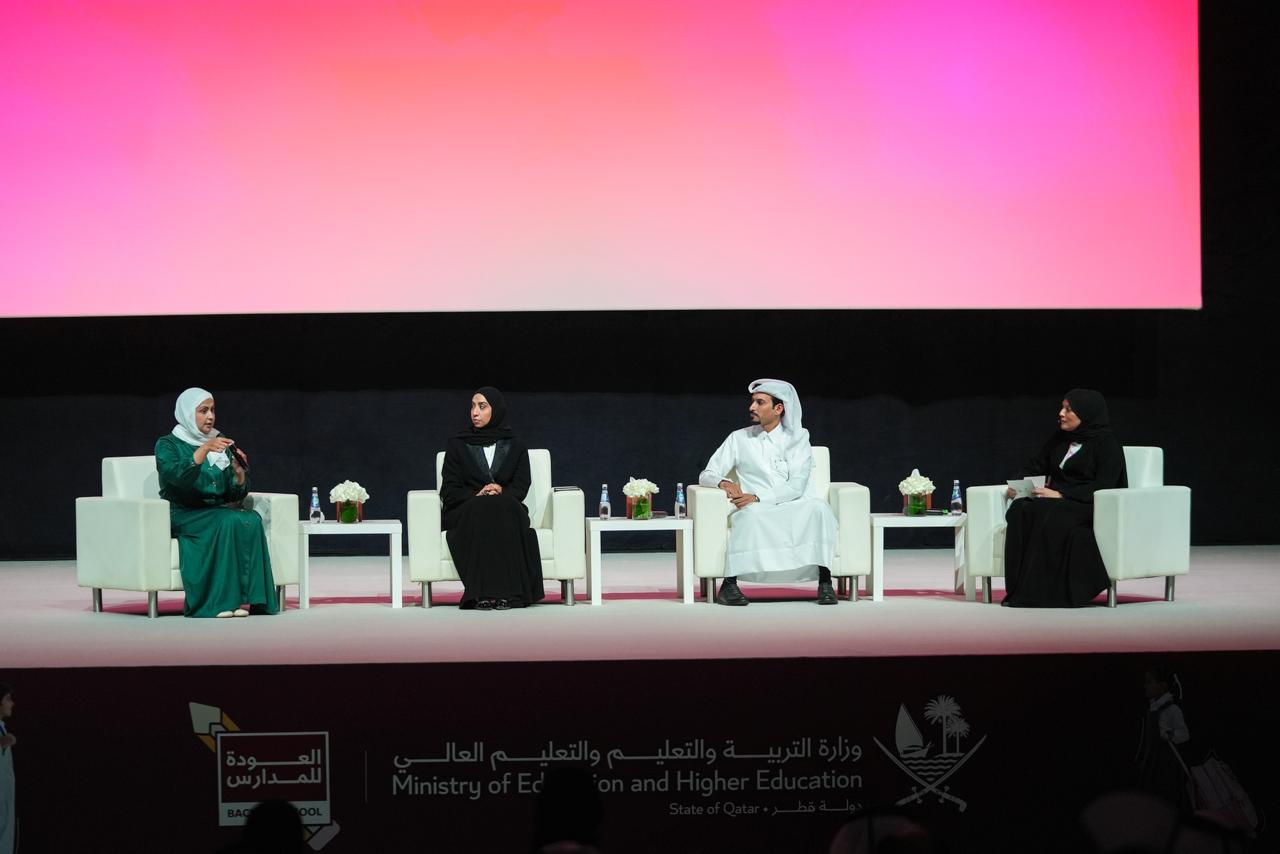
As part of the 2026 Annual Dialogue at the Ministry of Education and Higher Education in the State of Qatar, Her Excellency Sheikha Hessa bint Hamad bin Khalifa Al Thani, Chairperson of the Board of Trustees of The Center for Wellbeing, participated in a dialogue session titled “Human First, Authenticity as Strength, and Digitalization as Empowerment.” The session explored a range of issues related to human development within the educational environment, the strengthening of identity and values, and the roles of schools, families, and society in preparing students for a rapidly changing world.
The session was grounded in an integrated understanding of the human being, emphasizing that before being a recipient of knowledge, the student is a person with dignity, needs, emotions, and potential. The school, therefore, should be an environment in which students feel valued and important, with their presence at the heart of the educational process. Sheikha Hessa explained that putting the human first means ensuring that students feel important, respected, and valued; understand that their presence at school is connected to a greater purpose; and recognize that they are partners in fulfilling that purpose.
In this context, she highlighted the importance of integrating the spiritual, emotional, intellectual, physical, and social dimensions in developing the student, so that learning becomes a pathway toward building the human being and guiding them toward excellency. From this perspective, the school is an environment where students experience love, acceptance, and appreciation, develop their awareness and insight, and receive an education that takes into account their health and relationships with others.
From Values to Practice
With the beginning of the new academic year, Sheikha Hessa proposed that teachers begin with a simple yet profound question: “What can this student become?” She emphasized that the true role of the educator is to discover the inner potential within every student, and help them develop and translate them into reality.
She connected this to the importance of embedding values, drawing on the image of the “good tree” in The Holy Qur’an, whose roots are firmly grounded in the earth while its branches reach toward the sky. The more deeply values are rooted within the learner, the better equipped they become to remain grounded and continue to grow, even in a rapidly changing world.
Among the practices she proposed was cultivating a sense of beauty in students, understood in a broad sense that extends beyond appearance to encompass spiritual, meaningful, ethical, and physical beauty. She explained that aesthetic education means teaching students to recognize and appreciate beauty within themselves and in others, and to transform what they learn in terms of knowledge and values into practices that refine the self and inspire beautiful words and actions.
She emphasized that this education begins with the educator. A teacher who appreciates beauty and embodies it in their conduct and relationships is better able to cultivate it in students. From an Islamic perspective, the beauty of creation is complemented by the beauty of character, making beauty a way of engaging with life and others.
A School Beyond the Classroom Walls
In translating the session’s theme, “Human First, Authenticity as Strength, and Digitalization as Empowerment,” into practice, Sheikha Hessa proposed that “the entire school should step outside”, meaning a transition from education that remains within the walls of the classroom to education in which every area of knowledge becomes an opportunity for action, practice, and lived experience.
Science is learned in order to discover and experiment, values are learned to be translated into behavior, history and identity are learned to understand their impact on society, and technology is used for research, innovation, and problem-solving, rather than merely for consumption. In this way, the human comes first by engaging students in learning and helping them discover their abilities, authenticity becomes a source of strength when values are transformed into lived reality, and digitalization becomes empowerment when technology is used to foster creativity and serve humanity.
“Be Beautiful, and You Will See Existence as Beautiful”
At the conclusion of the session, Sheikha Hessa bint Hamad addressed a message to the education community as the new academic year begins, encapsulated in the phrase: “Be beautiful, and you will see existence as beautiful.”
She emphasized that the more wholesome and brightly burning the flame within the heart of every educator, the more capable it is of igniting in students a love of learning, work, and service to society. She called on teachers to begin with themselves, practice mindful listening with their students, take into account their individual needs and differences, and create an environment in which every person feels valued, while continually engaging in self-reflection and remaining open to evaluation and counsel.
She concluded by emphasizing that the “good flame” (Al-Jathwa Al-Tayiba) is the driving force behind experiential knowledge, its source being Divine revelation that guides the human being, and its ultimate purpose being the worship of Allah and the fulfilment of humanity’s role as stewards on earth. Carrying this flame and transforming knowledge into action, beauty into conduct, and values into impact does not merely contribute to building one academic year; rather, it contributes to shaping a human who reflects the beauty of existence within themselves and throughout their community.
August 30, 2026
Ministry of Education and Higher Education